

Short answer, since I know you're standing in the pharmacy aisle trying to decide before your allergies wreck another night's sleep: I landed back on Breathe Right Extra Strength strips. I gave a reusable internal dilator, the small silicone kind sold under names like Mute, a real two-week trial first, because the idea of buying one thing instead of a box every month sounded appealing. It worked, to a point, but it never beat the strip for comfort or for how consistently it kept Casey from hearing me snore through the wall.
This comparison exists because I'd already spent six months wearing Breathe Right nightly and wanted to know if a reusable internal option could do the same job for less ongoing cost. Both styles work on the same basic idea, widen the nasal passage so more air gets through without your body reaching for its backup plan, breathing through your mouth. How they get there is completely different, and that difference showed up almost every night I tested them.
| Breathe Right | Mute Nasal Dilator | |
|---|---|---|
| Product | Breathe Right Extra Strength Nasal Strips | Mute Internal Nasal Dilator |
| How It Works | External adhesive strip with flexible bands that pull nostrils outward | Small silicone piece inserted inside each nostril to hold them open |
| Reusable | Single use, one strip per night | Reusable, same piece for weeks with cleaning |
| Ongoing Cost | Low per night, but never runs out of needing restocked | Higher upfront, no restocking once you own it |
| Comfort Overnight | Disappeared after a few minutes, never felt it once asleep | Noticeable pressure inside the nostril, especially early nights |
| Visibility | Clear strip across the nose, visible but not bulky | Sits inside the nose, invisible from the outside |
| Fell Out or Loosened Overnight | Rare, only when applied to damp skin | Happened several nights, found it on the pillow or sheets |
| Snoring Reduction (per Casey) | Consistently quieter, most nights | Some nights quieter, some nights no real change |
| Best For | Anyone wanting the most consistent nightly result and doesn't mind a visible strip | Anyone who hates the idea of a nightly consumable and can tolerate an adjustment period |
How We Compared Them
I wore the Mute-style internal dilator every night for two straight weeks first, then switched to Breathe Right for two more weeks, same bedtime, same side of the bed, same pillow. Casey kept the same nightly log she'd used during my original six-month strip review, noting whether she heard snoring, how loud, and whether it woke her up. I also tracked my own morning congestion on a simple one to five scale, same as before, so the numbers would actually line up against my old data instead of starting from scratch.
Biscuit, our dog, ended up being an accidental part of the test again. She sleeps at the foot of the bed and reliably moves down onto the floor when my snoring gets bad enough to bother her. During the internal dilator weeks she relocated off the bed four separate nights. During the Breathe Right weeks that only happened once, on a night I had a head cold bad enough that nothing short of decongestant spray was going to fully open things up.
I also tried to be fair to the internal dilator by giving it a real adjustment period instead of quitting after one uncomfortable night. Several reviews online mention it taking a few nights to stop noticing something sitting inside your nostril, so I stuck with it through the full two weeks even on the nights I almost pulled it out at 2am.

Where Breathe Right Wins
Comfort was the biggest gap between the two, and it wasn't close. Once I pressed a Breathe Right strip on and got in bed, I genuinely stopped feeling it within a couple minutes, the same as I found during my original six-month review. The internal dilator never fully disappeared the same way. I felt a faint pressure inside each nostril most nights, especially in that first week, and while it did fade somewhat by night ten or so, it never got as forgettable as tape across the bridge of my nose.
Consistency mattered even more than comfort once Casey's log came back. Across the two weeks with Breathe Right, she noted quieter breathing on eleven of fourteen nights. With the internal dilator, that number dropped to seven of fourteen, roughly half. Some nights it worked as well as the strip, other nights it barely seemed to help at all, and neither of us could figure out a pattern to explain the difference. Breathe Right's outward pull on the nostril seems to happen the same way every single time you press it on, where the internal piece's fit felt slightly less predictable night to night depending on exactly how I'd positioned it going to sleep.
The internal dilator also came out on its own more than I expected. I woke up to find it on the pillow, or once tangled in the sheets, on five separate nights out of fourteen. A strip that loosens from damp skin is a known, fixable problem, dry your face fully before applying it and it stops happening. A small silicone piece working itself loose from inside your nose while you're asleep isn't something you can really troubleshoot the same way, it's just going to happen sometimes depending on how much you move around.
There's also the head cold test. I caught a mild cold during week two of the Breathe Right stretch, the same kind of test that impressed me during my original six-month review. The strip still noticeably widened the passages that weren't fully swollen shut. I didn't get a head cold during the internal dilator weeks to compare directly, but based on how much harder it was to get a snug, reliable fit even on a clear night, I doubt it would have handled congestion any better, and possibly worse, since a swollen nostril has less room for an internal piece to sit comfortably at all.
Casey's log doesn't lie, eleven quiet nights out of fourteen with the strip
If you want the version that worked more consistently and disappeared the moment you fell asleep, check today's price and current availability on Amazon.
Amazon Check Today's Price on Amazon →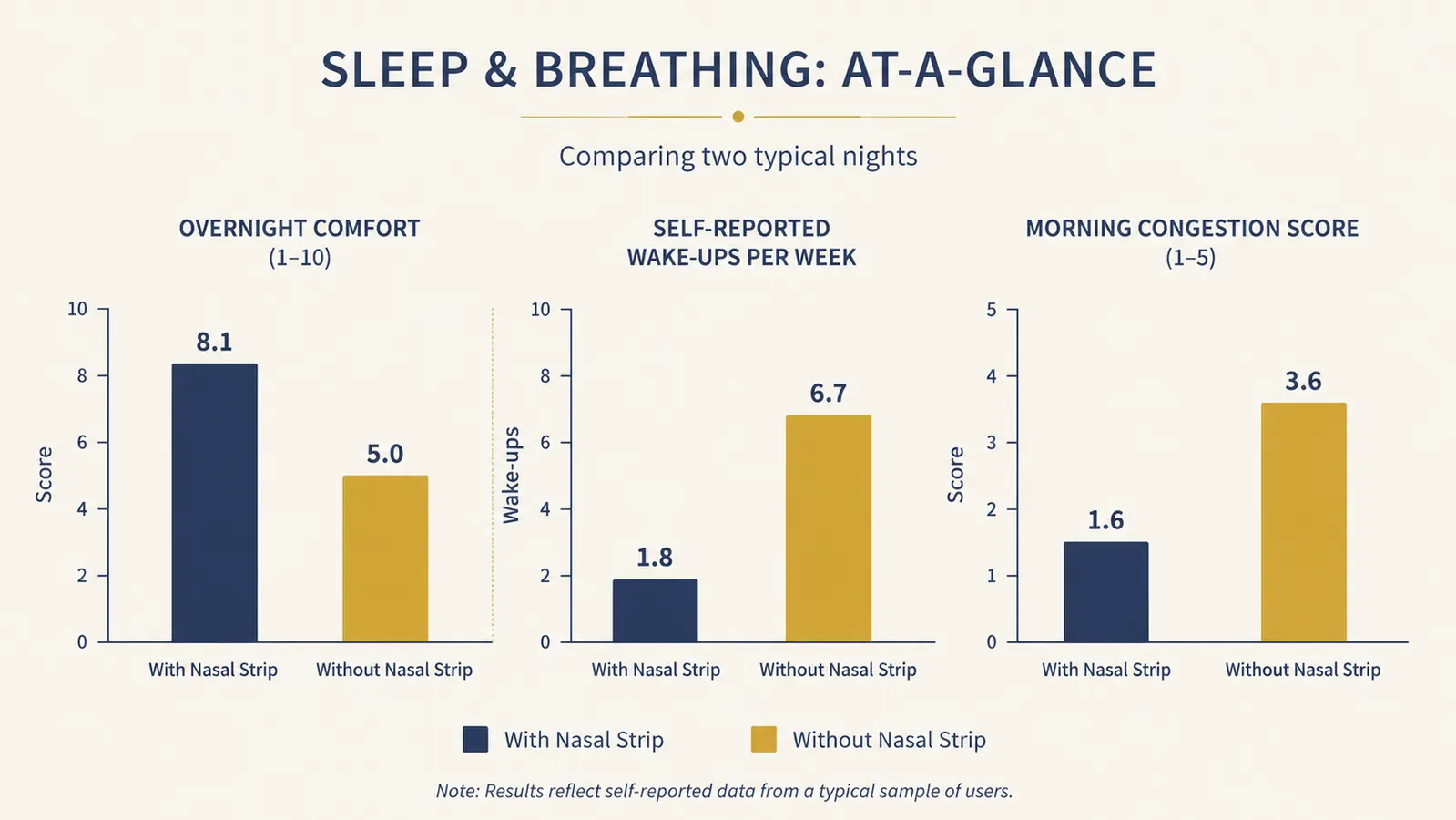
Where Mute Wins
Credit where it's due, the biggest thing an internal dilator has going for it is that you buy it once. After the initial cost, there's no monthly trip to restock, no perforated sheet to tear strips off of, no box sitting on the nightstand that eventually runs empty on a night you need it most. If the idea of a nightly consumable genuinely bothers you, whether for cost reasons or just the clutter of an empty box, that's a real advantage and I won't pretend otherwise.
It's also completely invisible. Nobody sharing a room with you, whether that's a partner, a hotel roommate on a work trip, or a kid who wanders in at midnight, is going to see anything unusual on your face. Breathe Right is clear, but it's still a strip sitting across the bridge of your nose, and if the idea of anyone noticing that bothers you even a little, an internal piece removes that concern entirely since there's nothing visible from the outside.
For someone with genuinely mild congestion, not the structural narrowing my allergist pointed out on my left side, an internal dilator might work just fine without the inconsistency I ran into. My case involves both a real anatomical quirk and whatever congestion the season throws at me, so the external strip's stronger, more consistent outward pull mattered more for me specifically. Someone with a straightforward, mild snoring issue and no structural component might get a cleaner result from the internal option than I did.
It's also worth saying the adjustment period is real but not permanent. By night ten or eleven, the pressure I felt on night one had faded to something closer to background noise, not gone entirely but far less distracting than it was at the start. If you're someone who adapts easily to new sensations while falling asleep, that curve might flatten out faster for you than it did for me, and the long-term value of a reusable piece becomes more appealing the longer you actually stick with it.
The First Week, Side by Side
The difference showed up almost immediately. Night one with Breathe Right felt exactly like it did during my original six-month test, a strange tightness across my nose for the first few minutes, then nothing, then I was asleep. Night one with the internal dilator was rougher. I woke up twice, both times reaching up to check if it had shifted, and Casey mentioned I'd been more restless than usual, tossing and turning more than she was used to.
By night four, Breathe Right had settled into the exact same background-noise comfort level it always does for me, boring in the best way. The internal dilator was better by night four too, but still noticeably present, enough that I found myself thinking about it right before drifting off instead of forgetting about it the way I do with a strip. Jonah, our three-year-old, actually asked why I had a "nose sticker" during the strip weeks, which at least got a laugh out of the whole thing. He didn't notice the internal dilator at all, for obvious reasons, which I suppose is its own kind of point in its favor.

Cost Over a Year of Nightly Use
I ran the math after both trials wrapped up, since the whole reason I gave the internal dilator a shot in the first place was the promise of paying once instead of buying a box every month. A year of nightly Breathe Right strips adds up to a real, ongoing cost, there's no getting around that, and it's the one place the reusable dilator has a genuine structural advantage if it holds up in reliability the way it promises to.
The catch is that the math only works if the reusable piece actually gets used every night for the long haul. Mine came out on its own often enough in just two weeks that I have real doubts it would survive a full year without needing a replacement anyway, and once you factor in a mid-year replacement, the cost gap between the two starts to shrink a lot faster than the packaging suggests. For me, the extra reliability of the strip was worth paying for nightly. For someone whose fit is snugger and more secure than mine turned out to be, the reusable option could genuinely pay for itself.
Biscuit only left the bed once during two weeks of Breathe Right. She left it four times during two weeks of the internal dilator. The dog's vote counted for something.
Who Should Buy Which
If you want the option that worked more consistently, felt completely forgettable once you fell asleep, and has six months of my own nightly data plus this two-week head-to-head backing it up, go with Breathe Right. It's the one Casey noticed a real difference from, and it's the one I've already gone back to using every night since this comparison wrapped up. If a nightly consumable genuinely doesn't work for your budget or your habits, and you don't mind a rougher first week or two while you adjust, an internal dilator like Mute is a reasonable alternative worth trying, just go in expecting a less predictable result night to night than what a strip delivers.
With two kids, a dog who treats the bed like an alarm clock, and a wife who notices everything the moment it changes, consistency won out over novelty in our house. I'd still tell a friend with mild, occasional congestion and no interest in a nightly consumable to give the internal option an honest two-week try. Just don't be surprised if, like me, you end up back at the pharmacy picking up a box of strips before the month is out.
The one that actually kept quiet more nights than not
Between the two, Breathe Right was the more consistent, more comfortable option in our house. See today's price and current availability on Amazon.
Amazon Check Today's Price on Amazon →