

Almost 25,000 people have reviewed the ComfortSpa reading pillow on Amazon, and if you skim even fifty of those reviews you'll notice they all say roughly the same four things: comfortable, sturdy, great for a bad back, would buy again. What you won't find in almost any of them is what actually trips people up after they've owned it for a while. Nobody mentions where you're supposed to put this thing during the day when you're not using it. Nobody mentions that it feels almost too stiff for the first couple of weeks. Nobody gets specific about what really happens to that cover after real washes, not just one gentle test cycle for a photo. And almost nobody talks about whether the backrest height actually works if you're not built like the average reviewer.
I already wrote a full long-term review of this exact ComfortSpa pillow after using it nightly for months, and that piece covers the day-to-day experience in detail. This one is different on purpose. This is the stuff I had to figure out for myself because the marketing copy and the glowing reviews conveniently leave it out. If you're on the fence about buying one, these are the four questions I'd want answered before I handed over my money.
The Quick Verdict
Still a solid, sturdy bed rest pillow that I'd buy again, but it has real gotchas around storage, break-in stiffness, and fit that the five-star reviews conveniently skip.
Amazon Check Today's Price →Before you buy one, here's what the five-star reviews leave out.
It's a genuinely good bed rest pillow. It's also bulkier than the photos suggest and stiffer than you'd expect on day one. Read the honest version first, then decide.
Amazon Check Today's Price on Amazon →How I Actually Tested This, Not Just Used It
Using the ComfortSpa bed rest pillow every night for a few months tells you a lot, but it doesn't necessarily surface the questions a new buyer actually has. So beyond the nightly use, I deliberately went looking for the gotchas. I moved it off the bed and left it standing in different spots around the bedroom for a week just to see where it actually fits. I ran the cover through three different wash settings instead of always using the gentle cycle, because that's what most people will actually do once laundry day gets busy. And I had two other adults in the house, one noticeably taller than me and one noticeably shorter, sit up against it so I wasn't just reporting on how it fits my own frame.
None of that required a lab coat or a stopwatch. It just required treating the pillow like an actual piece of furniture that has to survive a real household, not a review sample sitting pristine in a photo studio. That's the version of this pillow I want to tell you about.
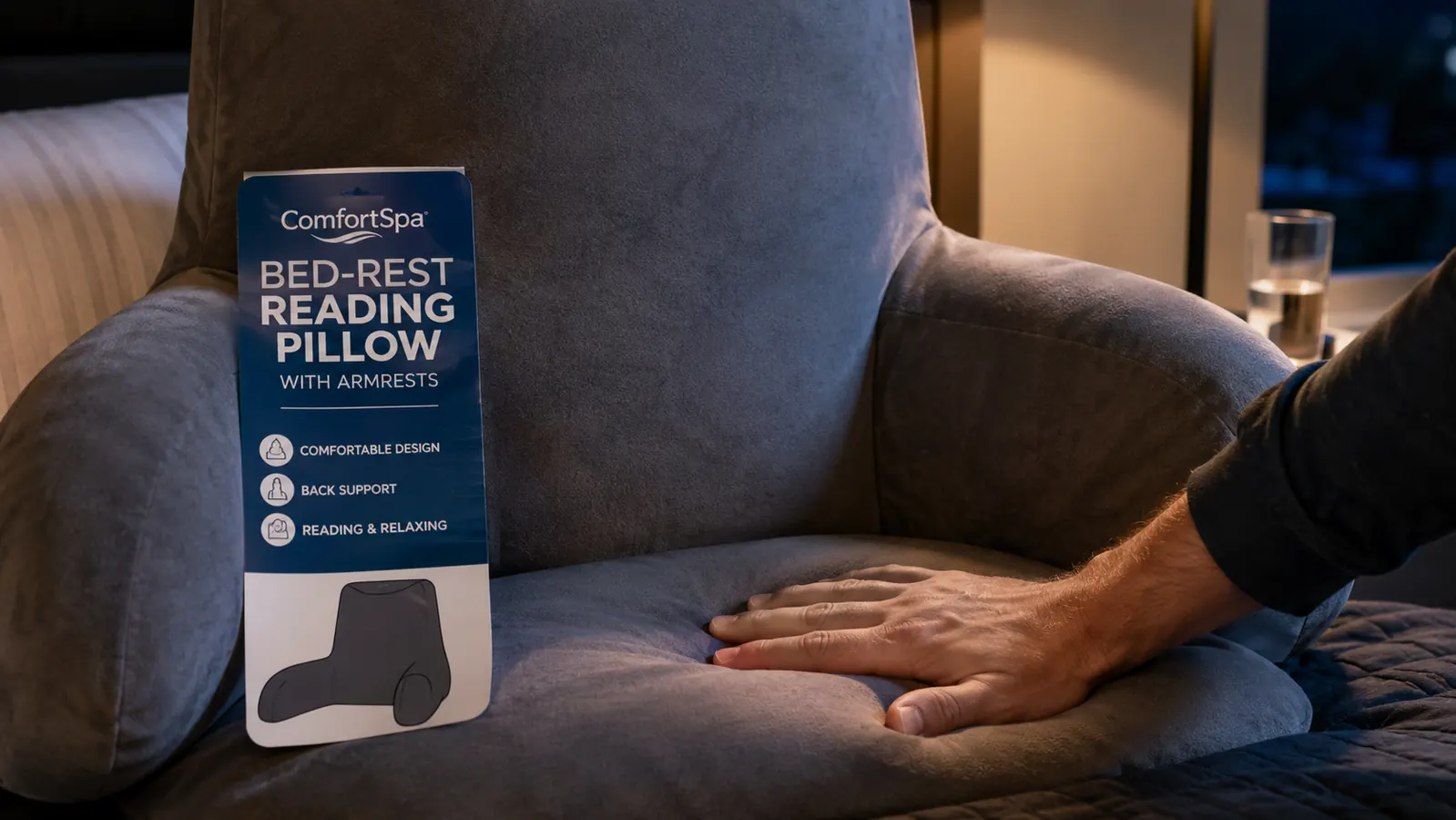
What the Product Photos Don't Show You: Where This Thing Lives All Day
Here's the thing nobody mentions until you already own one. This pillow is large, and it doesn't fold, roll up, or compress in any meaningful way. Every product photo shows it neatly propped against a headboard, looking tidy and compact. What those photos don't show you is what happens during the day when you're not sitting up reading, or when someone wants to strip the bed and actually make it look presentable. In our house it ends up in one of three places: leaned against the wall next to the closet, shoved into the gap between the headboard and the wall, or sitting on the floor at the foot of the bed looking like a piece of furniture that wandered in from another room. There isn't a graceful way to tuck it out of sight. If you've got a walk-in closet or a spare corner, that's a nonissue. If your bedroom is on the smaller side, this is genuinely something to think through before you buy, because you're committing floor or wall space to it, not just bed space.
I also assumed, wrongly, that I'd be able to prop it up behind the headboard and forget about it, letting it live there permanently. That works fine if your bed sits away from the wall enough to leave a gap. Ours is flush against the wall, so the pillow either has to come all the way off during the day or it stays wedged in an awkward spot that makes the bed look unmade even when it technically isn't. Small thing, but it's the kind of detail that changes how you'd actually use this day to day, and it's exactly the kind of detail a five-star review written the week you unbox something never gets around to mentioning.
The workaround I landed on after a couple weeks of shuffling it around was simpler than I expected. I keep an old throw blanket folded over a chair in the corner of our room, and the pillow just sits on top of that during the day, which keeps it off the floor and gives the corner a slightly more intentional look instead of a random object dumped in place. It's not a real fix, it's a compromise, but it's the kind of small adjustment nobody warns you you'll need to make before this thing feels like it belongs in the room instead of just living in it.
The Break-In Period Nobody Warns You About
The first night I used this pillow, my honest reaction was that I might have bought the wrong thing. It felt stiff, almost like leaning against a padded board rather than a pillow. I actually went back and reread the listing to make sure I hadn't accidentally ordered a firmer variant by mistake. I hadn't. That's just how it feels straight out of the packaging, and none of the reviews I'd read beforehand had prepared me for that first impression.
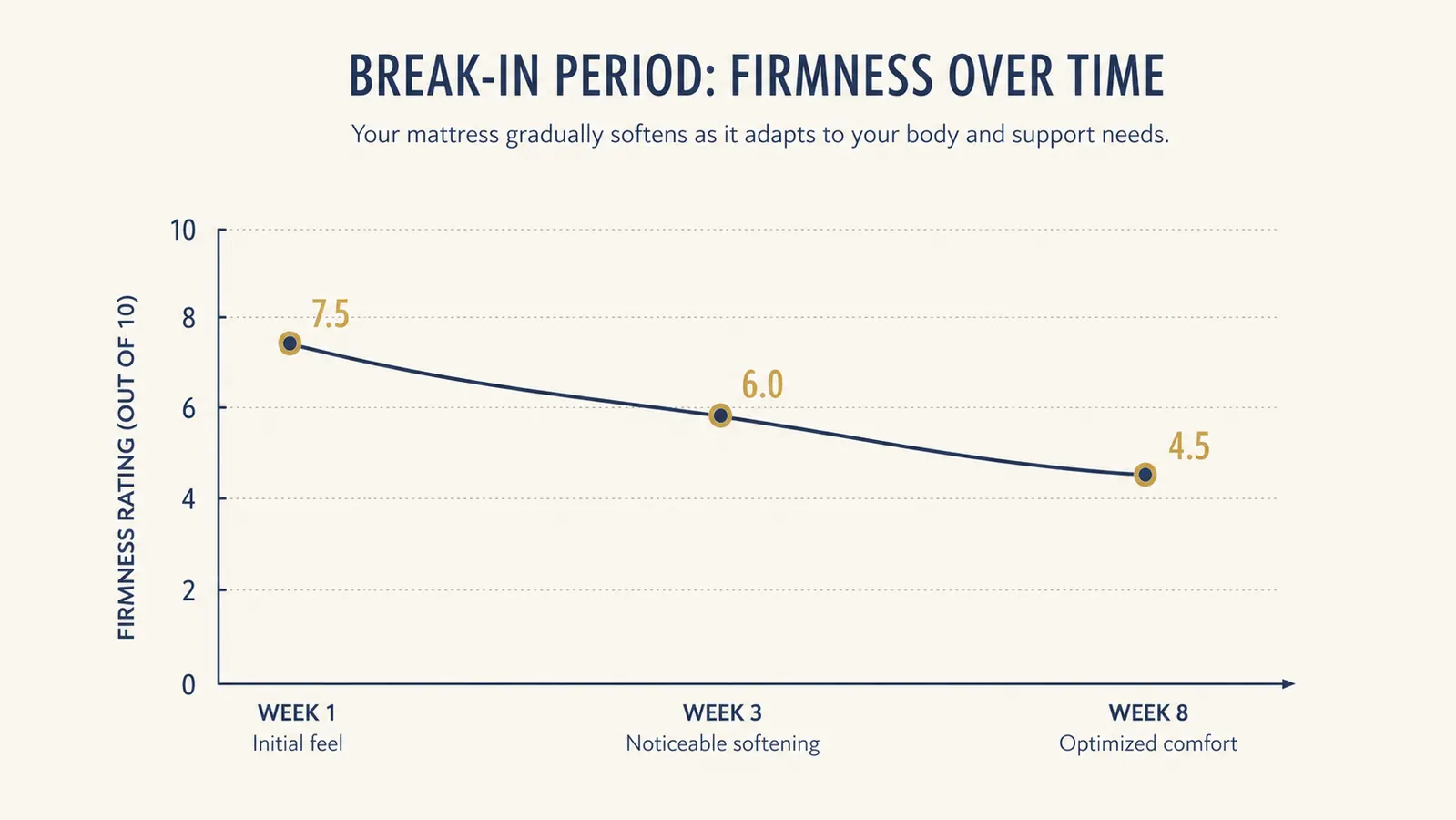
What changed my mind was giving it time instead of judging it after one night. By the end of week one, it had softened slightly at the points where I actually lean back, mostly across the lower back area, while staying firm everywhere else. By week three it felt noticeably more broken in, the kind of firm-but-forgiving feel that most of the glowing reviews describe, without ever mentioning that it took several weeks of actual use to get there. I tracked a rough firmness rating out of 10 each week out of curiosity, and it moved from an 8.5 on night one down to about a 6 by week three, then leveled off and barely moved between week three and week eight.
If you're the kind of buyer who orders something, tries it twice, and sends it back if it's not perfect immediately, this is exactly the product that could get an unfair one-star review for a problem that solves itself with patience. I'd have written a very different first impression after night one than I would after week three. Worth knowing that going in, because the break-in period is real and it's not something the packaging warns you about anywhere.
One thing that seemed to speed the process along, though I can't say for certain how much it actually helped versus just time passing, was sitting on the base cushion itself for a few minutes during the day a handful of times that first week, pressing my weight into it the way I would leaning back at night. It's a small, slightly odd habit, but the spots I pressed into during the day did seem to soften a touch faster than the parts I only ever leaned against at night. Take that with a grain of salt, it's one household's observation, not a lab result.
What Actually Happens When You Wash the Cover
The listing says the cover is machine washable, which is technically true and also not the whole story. I ran it through the wash three separate times using three different approaches specifically to see what would actually happen, because "machine washable" on a product listing can mean a lot of different things depending on how carefully you treat it.
The first wash, I followed the care instructions closely: cold water, gentle cycle, air dried flat. It came out looking identical to new, zero shrinkage, zero fading. The second wash, I got lazier, warm water, normal cycle, tossed it in the dryer on low with a load of towels because that's honestly what most people will do on a regular laundry day. It survived that fine too, though I noticed the zipper pull felt slightly stiffer afterward, like the dryer heat had tightened something in the mechanism just a touch. The third wash, I did the same normal-cycle, dryer routine again a few weeks later, and that's when I noticed the fabric had picked up the faintest bit of pilling right along the seam where the armrest attaches to the body of the cover, the spot that gets the most friction from being leaned on and grabbed to move the whole pillow around.
None of that is a dealbreaker. The cover still looks good from a normal distance and it's still doing its job. But if you're the type who cares about a product looking brand new indefinitely, know that repeated dryer cycles are where the wear actually shows up first, not the gentle cold-wash routine the listing photos were clearly shot around. Stick to air drying if you want it to hold up the way it does in the reviews.
Does It Fit Every Body, or Just an Average-Height Reviewer?
This is the question I almost never see answered honestly, probably because most reviewers are writing about their own body and assuming everyone else is built the same way. I'm a fairly average height, and the backrest hits me right where I want support, roughly mid-back to just below my shoulder blades, with the armrests landing right at elbow height when I settle in.
My wife, who's noticeably shorter than me, tried it for a week and found the backrest actually extends a bit higher than she needs, enough that the top edge sits closer to the back of her neck than her shoulder blades. It wasn't uncomfortable, but it wasn't the same tailored fit I get. Her workaround was sliding a thin regular pillow behind the base to shift her position slightly lower against the backrest, which solved it, but that's an adjustment she had to figure out on her own rather than something the product is built to handle out of the box.
On the other end, my brother-in-law is well over six feet tall and stayed with us for a few nights, so I had him try it too. For him, the backrest felt noticeably short, hitting mid-back rather than the upper back and shoulder support he actually needed. The armrests also sat a little low relative to his elbows, more of a forearm rest than a true elbow support. He didn't hate it, but he was clear that if he were buying this for himself, he'd want to know ahead of time that it's really sized around an average adult torso, not built to flex for someone well outside that range in either direction.
Put those two data points together and a pattern shows up pretty clearly. This isn't a one-size-fits-nobody product, but it's also not a one-size-fits-everybody product no matter what the single available size on the listing might suggest. If you're within a fairly normal height range, expect the backrest and armrests to land close to where you'd want them. If you're on either extreme end, plan on a small adjustment, an extra pillow for shorter frames, accepting a slightly lower armrest for taller ones, rather than expecting a perfect out-of-the-box fit.
What I Liked
- Genuinely comfortable and supportive once it's broken in, usually by week two or three of regular use
- Cover survives real-world washing, including dryer cycles, without shrinking or fading noticeably
- Sturdy enough that it doesn't feel flimsy or collapse under regular nightly weight
- Well suited to an average adult torso, backrest height and armrest position land naturally
- Holds up structurally even when handled roughly during daily moving on and off the bed
Where It Falls Short
- Feels stiff to the point of surprising you on the first night, before the break-in period kicks in
- No good way to store it out of sight, it takes up real wall or floor space when off the bed
- Repeated dryer cycles cause faint pilling near the armrest seam over time
- Runs a bit tall for shorter users and a bit short for anyone well over six feet
- Zipper pull felt slightly stiffer after a few dryer cycles, a small but noticeable wear point
The first-night stiffness almost got this a one-star review from me. By week three, it was one of the most-used things in our bedroom. Patience matters here more than any review will tell you.

Who This Is For
This makes sense for someone with a genuinely average adult build who has somewhere reasonable to store it during the day, whether that's a closet, a gap behind the headboard, or just a bedroom with enough space to spare. It's also a good fit for anyone willing to give it two or three weeks before forming a final opinion, since the out-of-the-box firmness is not representative of how it feels once it's broken in. If you do your laundry carefully and air dry rather than machine dry, the cover will hold up even better than my rougher test runs showed. And if you've already read plenty of glowing five-star reviews and wondered what they weren't telling you, hopefully this filled in the gaps honestly enough to make the decision easier either way.
Who Should Skip It
Skip this if you're significantly shorter or taller than an average adult and you're not willing to make small adjustments, like an extra pillow underneath, to get the fit right. Skip it too if you don't have a reasonable place to stash it during the day and a bulky object leaning in the corner of your bedroom would genuinely bother you. And if you're the type of buyer who forms a final opinion after one use rather than giving something a couple of weeks, this specific pillow is likely to disappoint you on night one for reasons that mostly resolve themselves by week three.
Now you know what the five-star reviews leave out. Here's where to get it.
Storage, break-in stiffness, and fit for taller or shorter frames considered, this is still a pillow I'd buy again. Just go in with your eyes open.
Amazon Check Today's Price on Amazon →